Tuesday, June 19

1923 Leica Serie-O {Prototype) Camera


' Westilicht Photographica Auctions a Leica 0-Serie Nr.107 (1923) camera sold for 1.3 million EUR (1.9 million USD). The opening bid was 200,000 EUR with an estimated price of 350,000-450,000 EUR. AP reports that the camera went to a "private Asian collector after a nail-biting, 20-minute bidding process".  This is the camera description:
This is the 7th camera of the Leica 0-series. Only approximately 25 of these cameras were produced to test the market in 1923, 2 years before the commercial introduction of the Leica A. It is the only camera known with “Germany” engraving on the top plate. The factory record indicates delivery to New York for patent applies. This means that this camera is not only one of the major existing rarities, it is also the first Leica being exported. It is the unique chance to see one of the most important collectible Leica cameras.'

Eugene Atget 1857-1927


"Eugène Atget never called himself a photographer; instead he preferred 'author-producer.' A private, almost reclusive man, Atget first tried his hand at painting and acting, then began to photograph vieux Paris (Old Paris) in 1898. He photographed in part to create 'documents,' as he called his photographs, of architecture and urban views, but he supported himself by selling these photographs to painters as studies. Atget carried a large-format view camera, an outdated, cumbersome outfit, through the streets and gardens of Paris, usually photographing around dawn; many of these areas--storefronts and public spaces in nineteenth-century Paris and Versailles--were demolished soon afterward to make way for rapid urbanization.

Though Atget was not well known during his lifetime, his visual record of a vanishing world has become an inspiration for twentieth-century photographers. American expatriate photographers Man Ray and Berenice Abbott rescued his work from obscurity just before his death. Abbott preserved his prints and negatives, and was the first person to publish and exhibit Atget's work outside of France. Many existing prints of Atget's images were, in fact, made by Abbott in the 1930s from his negatives."

Sunday, June 17

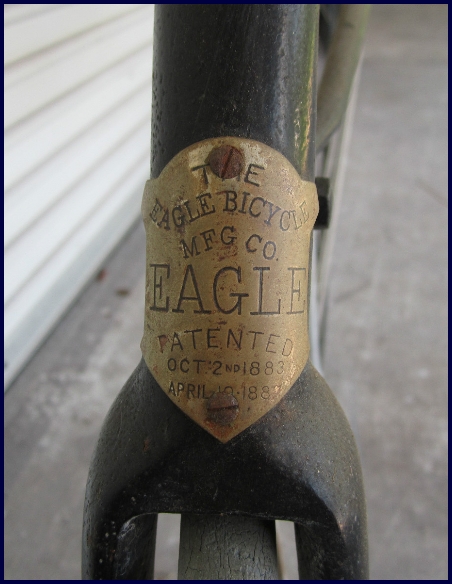
1883 Eagle Safety Bicycle


'Manufactured by The Eagle Bicycle Company in Torrington, Connecticut, Serial # 208
52" rear driving wheel with a 22" front steering wheel
The Eagle is the only high wheel safety that retained  the simple rotary crank of the large driving wheel.

The bicycle has the correct  seat, brakes and name plate. The pedals are incorrect, but work just fine. Both wheels spin true, no spokes missing in either wheel
Fresh out of the barn & is it is the first time this bike has seen the light of day in over 25 years. Can be ridden as is but has older tires that need to be replaced.'

Tuesday, June 12

1929 Kissel "White Eagle" Speedster


'Louis Kissel emigrated from Germany to Wisconsin, settling in the small town of Hartford 35 miles northwest of Milwaukee. By dint of thrift, diligence and industry by the late 19th century the family thrived, having moved from farming to commerce and industry. The two youngest Kissel sons, Will and George, began experimenting with automobiles, building their first, a 4-cylinder, shaft drive runabout, in 1905 in the family's farm implement factory and beginning production the following year. Eventually the Kissel companies added foundries casting aluminum, brass and iron, a body line and complete production facilities that built every Kissel nearly in its entirety from their own factories. Known for quality and reliability under engineer Herman Palmer and the attractive coachwork of J. Friedrich Werner, Kissels were favored by solid citizens and by not a few celebrities including even racer Ralph dePalma. Kissel competed head-to-head with Buick, Nash and Studebaker and held its own despite significantly higher prices.
 
 In stark contrast to Kissel's touring cars and sedans, from the marque's earliest years it carried a line of light, sporting roadsters starting with the Semi-Racer in 1911, continuing through the memorable Gold Bug speedster and culminating in the elegant, fast and sporty White Eagle by Kissel in 1929. It used a straight eight 298 cubic inch block bought from Lycoming, meticulously assembled and balanced in Kissel's factory and fitted with a Kissel aluminum cylinder head and oil pan. Horsepower is 126 and torque is 210 lb-ft. Advanced features were plentiful, notably Lockheed hydraulic brakes and adjustable spring shackles but it was the double-dropped frame which Kissel had employed for years that made the beautiful bodywork of the White Eagle possible. It was not enough to save the company, however, and it succumbed a year after the stock market crash. This 1929 Kissel White Eagle Model 126 Speedster is one of only two known survivors. 
 
The other is in the famed Nethercutt Collection. A third, powered by a smaller engine, is in a museum in Ohio. It is built on a long 139 inch wheelbase and is as spectacular as any speedster runabout of the late Twenties, a thrilling relic of the Jazz Age. Once part of Harrah's collection in Nevada, it was discovered at Hershey in 1978 by Ron Fawcett. An experienced restorer, Fawcett completely restored the White Eagle to standards that are impressive even today. Its design is marked by the deeply cut down doors and sweeping fenders and running boards with dual side-mounted spare wheels and tires with mirrors. The steering wheel is a manly construction out of fine wood including the spokes. It has center-lock chrome wire wheels with two-eared nuts, racks in front of both rear fenders carrying golf club bags,

 Ryanlite headlights with matching cowl lights, a single Pilot-Ray driving light, stainless steel radiator stoneguard, dual chrome horns. An unusually large rumble seat sits below the long, low rear deck with three steps along the right fender, a folding luggage rack and a center-mounted combination taillight by Teleoptic of Racine, Wisconsin. It is beautifully presented in bright red with maroon leather upholstery and a black cloth top that contrast vividly with the chrome wire wheels and blackwall tires. The fully-instrumented dashboard is highly varnished hardwood as solid and substantial as the Kissel it graces. Surely its most unusual feature, however, is its radiator cap mascot, a cast eagle with outstretched wings that are spring-loaded and flap as the Kissel White Eagle Speedster moves through the air.'

The Waterbury Clock Company

'The Waterbury Clock Company was formed March 5, 1857, as a joint stock corporation, the Waterbury Clock Company from its inception was an operation designed to be a major user of brass produced by the parent firm, the Benedict & Burnham Manufacturing Company. Utilizing the best talent available to them, they hired veteran clockmaker Chauncey Jerome to set up the new firm's case-making shop and his brother Noble Jerome, a well-known clock mechanic, to set up the movement manufacturing operation.


Though this firm became a major clock producer, after 1890 they became a major manufacturer of non-jeweled pocket watches, supplying R. H. Ingersoll & Brother, a major mail order firm. Large-scale production and profitability were enjoyed for more than two decades with this association as well as providing clocks for sale through the Sears catalogs of these years. Major factory expansions between 1900 and 1915 made this the largest clock manufacturing facility in America.
In 1922, the Waterbury Clock Company purchased the Ingersoll operation whose business had begun to sour after 1910 and had gone bankrupt two years previous because of poor management. Waterbury's operation began to decline and was particularly hard hit by the Great Depression.
By 1932, their huge factory complex was little used. They barely avoided bankruptcy, but the firm was reorganized as the Ingersoll-Waterbury Company with investors raising half a million dollars in new capital. During this period the popular "Mickey Mouse" character watch was made and electric clocks were added to the line.
After America entered World War II, the Ingersoll-Waterbury Company switched almost 100% to manufacturing war products. In 1942, the operation was purchased by a group of Norwegian investors and a new factory was built at Middlebury, CT. In 1944, the firm became known as United States Time Corporation and introduced the popular "Timex" watch shortly after the war. In November, 1969, U.S. Time was succeeded by Timex Corporation, which continues business at Middlebury, Connecticut.'

Wednesday, May 23

ThermoCap for Driving 1911 and 1910 Autoface Mask


Estate purchased from a long time automobilia collector, this antique 'Thermo Cap' cloth driving cap in amazing original condition, still supple with no holes, tears or condition issues, has yellow lens visor with fold down leather flaps that rest on the top of driving goggles. Made by Thermo Cap, has a patent date of June 13, 1911 and a manufacture date of January 5, 1915. A unique article of automobilia, museum quality. Great display piece. The antique 'Autoface' cloth driving mask in amazing original condition, still supple with no holes, tears or condition issues, has glass, leather reinforced lenses that serve as built in driving goggles. This dates back to the earliest days of motoring. A very unique article of automobilia, museum quality

Monday, April 30

Miller Peacock-Finial Table Lamp circa 1910


'Stunning pink and green slag glass overlay table lamp produced by the Miller Lamp Company about the years 1908 to 1920. Clearly marked underneath the base with “MILLER” and the number “956”. Including the finial, the lamp stands around 24.5 inches tall with a shade diameter of 18 inches (it is 8-sided). The base has a diameter of 7 inches.

The metal overlay shows a floral & trellis design (possibly Morning Glories or Calla Lilies) around the edge which covers the green glass panels… 2 shades of green! A leaf motif tops of the overlay near the finial – the leaves point down through the pink panels towards the flowers. The metal stand ends in a base that also shows a floral design, possibly roses.

The shade contains 72 slag glass panels - 8 dark green, 24 light green and 40 pink. Many of the panels, if not all, are streaked with white coloring striations. The metal they fit in, on the inside of the lampshade, may be lead... I'm not sure about this, and am unwilling to test the metal in case I scratch it (but see picture 10 with the zoom feature). Sitting atop the shade is a majestic looking Peacock finial, with tail feathers fanned out, that holds a pink glass drop within its body. The peacock has some blue and red coloring on it.

The lamp works flawlessly and it really lights up a room with a warm pink and refreshing green shades.

The lamp appears to be in great shape for its age. The metal work does show a couple of scratches and it is fair to say the glass will need cleaning. The light fixtures and power cord may be replacements. The drop within the peacock may need refitting as the wire holding it does not allow for it to sit snugly, and the Peacock itself has some paint loss. There are no chips or cracks in the glass panels – there are creases in some from the manufacturer.'

Saturday, April 21

1920 Kissel 6-45 Speedster "Gold Bug"

'The Kissel  "Gold Bug" Speedster is one of the most honored and appreciated early sports cars in America, joining the Mercer Raceabout and Stutz Bearcat among the performance royalty of the century's first quarter. Powered by a 61hp side valve six and sporting dramatically low, streamlined two-seat bodywork, the Kissel Gold Bug's other claim to fame is the pair of occasional seats which slide out from the bodywork just behind the passenger compartment to take two very brave (or foolhardy) passengers along for the ride of their lives. 


The Kissel's 6-cylinder engine gives it exceptional performance and smooth, torque and power not enjoyed by its competitors. This 1920 Gold Bug is presented in the brilliant yellow livery that characterizes the model and giveit its name, set off                                                                         by black leather upholstery and a black cloth top.


Yellow wire wheels with black-wall tires complete the Gold Bug theme and the radiator proudly wears a Kissel-badged winged Motometer. It was comprehensively restored in the United States before being acquired by a French collector who has thoroughly maintained it both mechanically and cosmetically while enjoying it frequently in tours throughout the Continent over the past several years. It has pullout seats on both sides, two luggage trunk openings in the turtleback rear deck and a rear-mounted spare wheel and tire. Its frequent long distance tours in Europe have demonstrated its reliability but it also has been consistently cosmetically maintained and freshened as needed so it is today one of the finest examples of its rare marque and model, a Gold Bug that can be counted on to provide exceptional performance and satisfaction on the road while being ready to be displayed with confidence at the end of a day's tour. The early American concept of a sports car is nowhere better exemplified than in this exceptional 1920 Kissel 6-45 Gold Bug Speedster.'.

Friday, March 30

The Marmon 34 "Roosevelt"


'Howard C. Marmon's first prototype was manufactured in 1902, and proved just how forward thinking the automotive pioneer was. The car featured an 90° twin-vee overhead valve, air-cooled engine with pressure lubrication, the earliest automotive application of a system that went on to become the universal formula for internal combustion engine design.
The first Marmon's used a separate sub-frame for engine and transmission, while the suspension featured a somewhat primitive attempt at creating an independant setup. By 1909 things had become somewhat more conventional, the air-cooled engines being replaced by T-head inline four cylinder engines.
In 1911 came the "Straight 6" Model 32 that was fitted with a rear axle transmission, then in 1916 came the OHV six cylinder Model 34, which featured extensive use of aluminum including the cylinder block, most engine components (including pushrods), body, hood and radiator shell.
To gain publicity, in 1916 Howard Marmon's team of drivers drove a Marmon 34 across America in pursuit of the trans-continental record. They did it in under six days, beating the legendary Erwin "Cannonball" Baker's record Cadillac time by 41 hours.
The Model 34 remained in production until 1924, and as the revised Models 74 and 75, until 1928. The Model 34 would enjoy a long production run, continually evolving in the process as better automotive technologies were developed. These included such things as Delco coil ignition in 1920, and the option of front wheel brakes in 1923.

The first (financial) cracks in Marmon appeared in 1924, with sales of the Model 34 having been in decline for some time. George Williams (former president of the Wire Wheel Corp. of America) helped rejuvenate interest and inject some much needed cash, and sales rose from about 2,600 in 1924 to almost 4,500 in both 1925 and 1926. But Williams was convinced that to really prosper, lower priced cars were needed.
The previous success of the Model 34, combined with Williams "keep it cheap" ethos helped pave the way for the development of two "Straight 8" iterations. The first to hit the market was the 1928 Model 68, which sold for a low $1,395. Then came arguably the best known Marmon of all, the 1929 "Straight 8" Roosevelt. The Roosevelt was unbelievably cheap, and took the honours as being the first 8 cylinder car to sell for less than $1000. Better still, it was also the first ever car to be fitted with a factory installed radio.
The low price put the Roosevelt within reach of those that previously had to settle for 4 or 6 cylinder cars, and in its first year of production Marmon managed to sell 22,300 - a huge number at the time. There were plenty of body variations available, including a 2 door Coupe, 4 door sedan with 5 seats, and a 4 seat 2 door convertible. Some of these found their way to Australia.
But in an era of extravagance, it seemed most automotive manufacturers were intent on building lower volume prestige cars for the well-heeled - and their timing could not have been worse. Marmon set about building the magnificent 200 horsepower V16, which featured a beautiful body penned by Walter Dorwin Teague. At the time the "Marmon Sixteen" was the largest passenger vehicle on the market, and even before production commenced in 1931 the Society of Automotive Engineers honored Colonel Marmon's new V16 engine as being "...the most notable engineering achievement of 1930".
The new car was born into the Depression, and not suprisingly only around 400 managed to find a home. A more cost effective 8 cylinder version was built in 1932, but that was short lived. Marmon ceased automobile manufacture in 1933, and we can only speculate now as to whether the company could have remained viable if they had of stuck to the low cost "Straight 8" formula established by the Roosevelt.'

Monday, March 12

Very Rare 1923 Chevrolet Superior Mercury Body Sportabout


'Mercury Body Corporation of Lexington, Kentucky was organized in early 1920 and submitted a speedster body design to the US patent office which was approved in November of that year. The sleek prototype speedster was well received and the firm was capitalized with an announcement that production of five bodies per day would commence on September 1st, 1920 in the firm’s Cincinnati, Ohio manufacturing facility. They also planned on producing a “closed body for winter use”. Plans for the Cincinnati plant fell through and in early 1921 a new factory was located in Louisville, Kentucky.
In 1921 a western sales branch was established in Los Angeles. Organized as Pulliam & Pulliam Motor West, announced that the firm was Los Angeles latest entry in the growing automotive manufacturing field. Period advertising stated that Pulliam & Pulliam were the manufacturers of the Mercury Sport Body:


“IT’S A FORD! WITH A PULLIAM & PULLIAM MERCURY SPORT BODY!”
In 1923 Pulliam & Pulliam sponsored Frank Gegoux and his Mercury Speedster "Desert Pal", in a record-breaking 7-day trip from Los Angeles to New York.
Mercury’s two-passenger speedster body was originally designed for the Ford Model T chassis, but in 1923 they introduced a slightly modified version for use on Chevrolet 490 or Superior chassis. Although McCormick’s original design did not include any doors, the firm's Super Sportabout line included a passenger side door in response to customer requests. Mercury’s products were sold either direct or via regional Ford and Chevrolet dealers in the Untied States and Canada.
Over time, the demand for Mercury’s Speedster body declined and the firm turned to producing commercial bodies.
The firm was sold and reorganized in 1926 as the Jackson Body Company, but soon after withdrew from buisness.


DETAILS ABOUT THIS SPECIFIC CAR...
As detailed above, the majority of these bodies were manufactured in small numbers for the Ford Model T. It was not until late in the company’s existence that they began to make these bodies for Chevrolets.
This body is one specifically designed for a Chevrolet and has not been adapted from a Model T body. The main differences between this body, and those made for the Model T, is that this is a full-fendered car making it a “sportabout” rather than a “speedster”. This body was designed specifically for the Chevrolet exterior body parts (hood, fenders, etc.) and includes a single “suicide” door on the passenger side. The car also was also designed specifically for Chevrolet interior features such as gauges, steering, etc. This mercury body sportabout is one of only three known to exist in the world that was originally sold specifically for a Chevrolet Superior Chassis.
Because the 1923 through 1926 4 cylinder Chevys  transformed into these Mercury Body Sportabouts and how rare they are explains the  reason for inclusion here. It is my understanding that this car was purchased in 1923 at a Chevrolet dealer in Los Angeles and never left the area. This is supported by the fact that the car was complete and in excellent, rust free, condition when purchased from him in 1990.'
'There are very few Mercury Body cars that still exist, the majoirty of which are speedsters made to fit on a Ford Model "T" frame.  This Chevrolet Mercury Sportabout is much more rare, one of only three known still to exist that was manufactured to specifcially sold as a Chevy.  One of the others in partially restored in the Northwest, and the other was purchased by Chevrolet for their collection several years ago and is stored in a warehouse.
This Chevrolet Mercury Sportabout has underwent a complete body off first class restoration to original condition. This car is mechanically perfect and a great driver.'